A flat roof that leaks in winter is usually leaking because melt water can’t drain. Snow melts in a warm spell or a chinook, the water runs to a drain or scupper that’s blocked with ice or grit, and it backs up into the nearest weak seam or flashing.
That’s why so many winter leaks show up in a thaw and stop when it freezes again. Here’s where the water gets in, what to do tonight, what a repair costs in Calgary, and how to keep it from happening next winter.
Why does a flat roof leak in winter and not in summer?
Winter keeps water on the roof for longer. Summer rain runs off in an hour or two. A melting snowpack keeps feeding water to the drains for days, and when that water freezes overnight it expands in any gap it has found.
The City of Calgary reports a 30-year average of 128 freeze-thaw cycles a year. Each one can open a seam or a crack in the flashing a little further, so a weak spot that stayed dry all summer starts dripping in January.
Where do flat roofs leak most in winter?
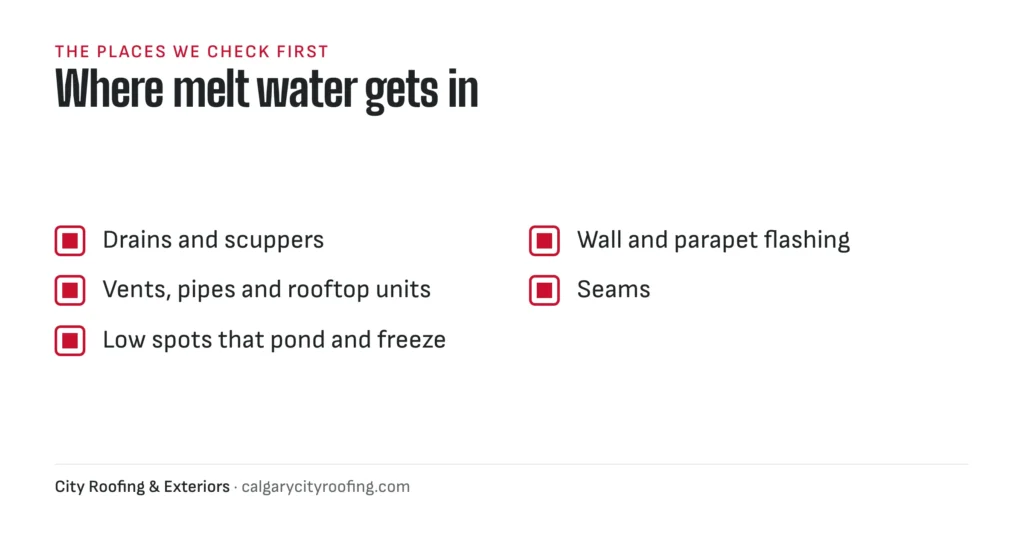
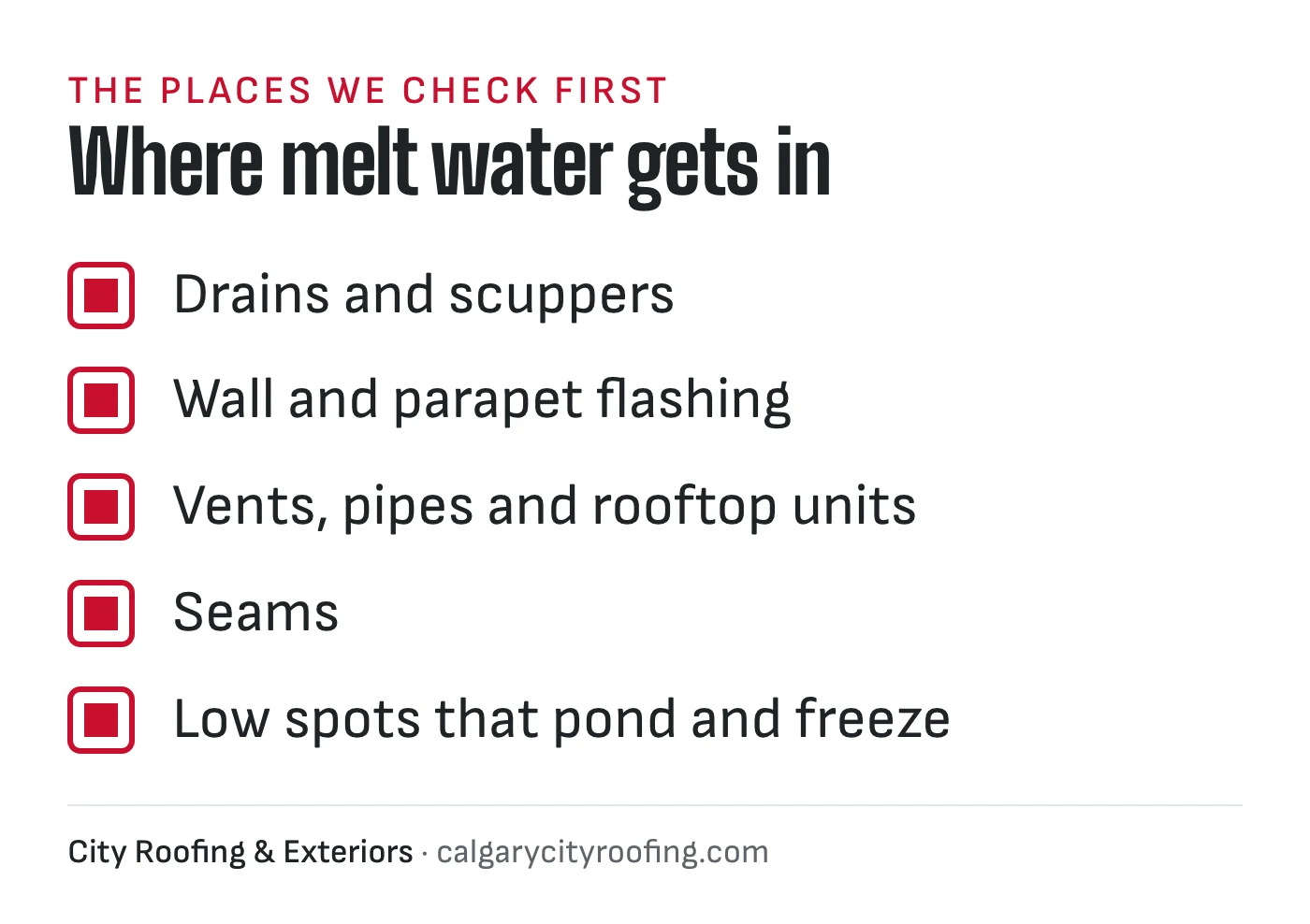
Most winter leaks start at the low points and the edges, where melt water collects. These are the places we check first:
- Drains and scuppers, when ice or grit blocks them and the water backs up.
- Where the roof meets a wall or parapet, if the flashing has cracked or pulled away.
- Around vents, pipes and rooftop units, where the seal has aged.
- Seams, where one sheet of membrane overlaps the next.
- Low spots where water ponds and then freezes.
Water also runs along the deck under the membrane before it drips through. The stain on your ceiling is rarely under the hole, so finding where the water actually gets in is the first job.
What should you do tonight if your flat roof is leaking?
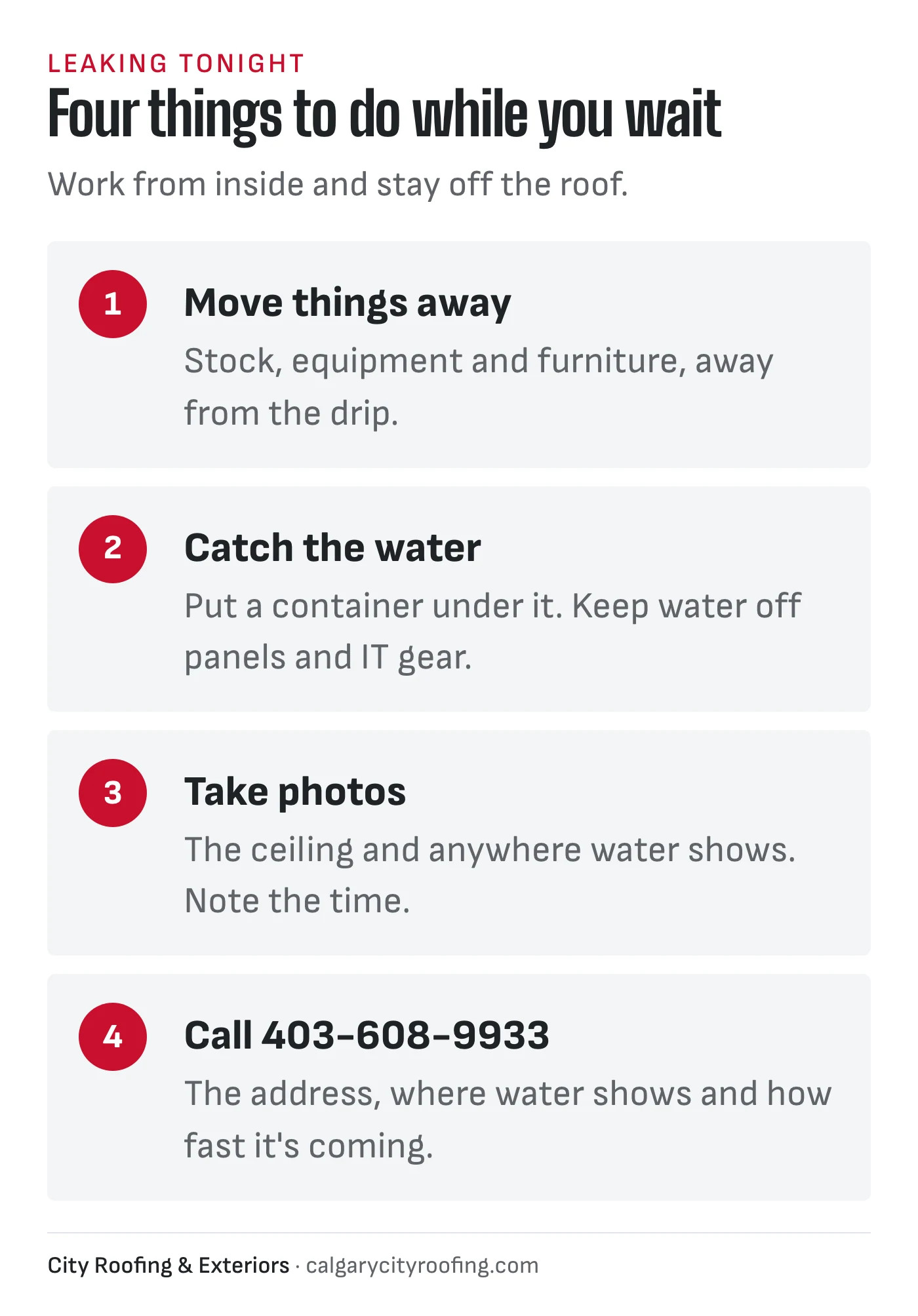
Work from inside and stay off the roof. A wet, icy or snow-covered flat roof is easy to fall from, and the snow hides skylights and soft spots.
- Move stock, equipment and furniture away from the drip.
- Put a container under it, and keep water away from electrical panels and IT gear.
- Take photos of the ceiling and anywhere water is showing, and note the time.
- Call 403-608-9933 with the address, where the water is showing and how fast it’s coming in.
Don’t chip ice off the roof with a shovel or a pick. One cut in the membrane turns one leak into two. On a business or condo building, here’s what happens on an emergency roof repair callout.
Can a flat roof be repaired in winter?
Yes, though a winter repair is often a temporary one. Cold, snow and ice limit what can be done properly, so the first job is to stop the water. The lasting repair waits for better weather if it has to.
One customer called Jacky, our Service Manager, in December. Jacky sent the team out for temporary repairs, and the roof was replaced in spring. Planned work can go ahead in winter too. We put the Propak roof on through the snow, one section at a time.
Is it a roof leak or condensation?
On a house or a top-floor condo, winter water isn’t always a leak. Frost builds up under the roof during a long cold snap, then a chinook melts it all at once and it drips through the ceiling. That’s attic rain, and under a low-slope roof it looks identical to a leaking membrane.
The pattern gives it away. Attic rain shows up as scattered spots, often mid-ceiling and at lights and fans, right after a long cold snap breaks. A roof leak tends to drip in the same place every thaw. Our attic rain or roof leak check walks through how to tell them apart.
What does a winter flat roof leak cost to fix in Calgary?
Most flat roof leak repairs on houses run $350 to $2,500. On commercial buildings, minor leak repairs usually run $600 to $2,800, and an emergency callout to find and control an active leak runs $1,500 to $5,000 or more.
| Job | Typical cost |
|---|---|
| Flat roof leak repair, house | $350 to $2,500 |
| Leak detection inspection, commercial | $500 to $750 |
| Minor leak repair, commercial | $600 to $2,800 |
| Emergency callout, commercial | $1,500 to $5,000 or more |
| Drying out water damage inside | $3.00 to $7.50 a sq ft |
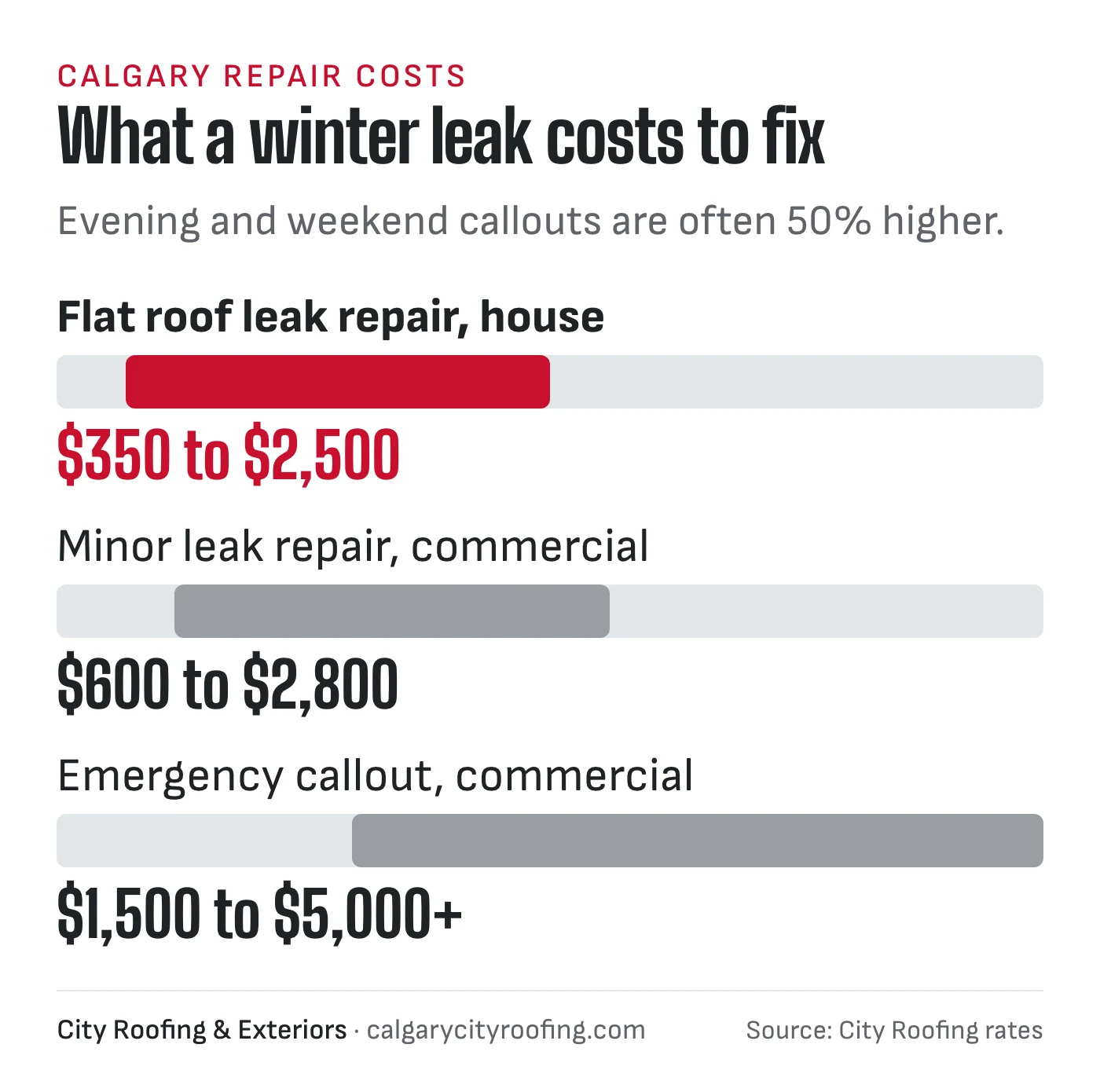
Evening, weekend and holiday callouts are often 50% higher. The callout finds and stops the water, and the permanent repair is priced separately in writing, so you see both numbers before the bigger one starts.
How do you stop a flat roof leaking next winter?
Get the roof checked in the fall, before the snow. Mark Dawson, our owner, tells property managers exactly that, because a fall check covers the places winter leaks start:
- Drains and scuppers cleared, so melt water has somewhere to go.
- Debris taken off the roof.
- Every vent, pipe and rooftop unit checked to make sure it’s sealed.
- Seams, flashing and the sealant at walls checked.
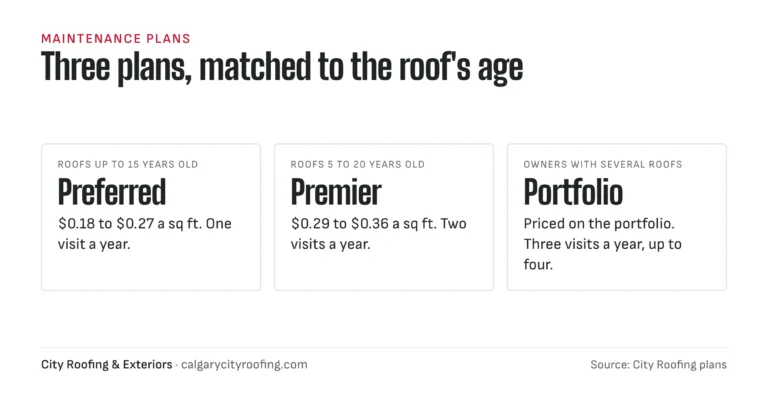
If the same spot leaks every winter, or water sits on the roof for days after a thaw, the roof may need more than a check. On a commercial building, a roof maintenance plan books the visits for you. Our flat roof repair page covers what a lasting fix involves.
Common questions
Why does my flat roof only leak when the snow melts?
A thaw is when water sits on the roof long enough to find a gap. Rain runs off, but snow melting in a chinook can feed a blocked drain for hours or days. Clearing the drain or sealing the seam is usually the fix.
Can I seal a flat roof leak myself in winter?
We’d advise against it. Most sealants need a clean, dry surface to bond, which a winter roof rarely is, and a snowy roof is dangerous to walk. Contain the water inside and call instead.
I can’t find where my flat roof is leaking. What now?
Water travels under the membrane, so the hole is often well away from the stain. A roofer starts at the drains, walls and penetrations nearest it. On a commercial roof, a leak detection inspection usually runs $500 to $750.
Does insurance cover a winter roof leak?
Often for sudden damage, and not for age or wear. Policies vary, so check yours and take dated photos before anything is repaired. Our roof insurance claim page covers how a claim works.
Water coming in now? Call 403-608-9933, Monday to Saturday, 8am to 7pm, or see flat roof repair in Calgary for what we check and what it costs.